ReStackor Home


Model Physics

  Stack Stiffness

    Shim Stiffness

    Force Balance

    Stack flow area

    Dyno stacks

  Fluid Dynamics

  Cavitation

  Spring mass damper

Dyno data


User Manual

Sample Applications


ReStackor Demo

  Download demo


Buy Now

  Shim ReStackor

  ReStackor pro


ReStackor Shim Stack Stiffness

Finally computer software to tune a shim stack

Calculation of shim stack stiffness and its effect on suspension damping requires three basic components:

  • Calculation of the stiffness of each individual shim. 

  • Calculation of the stack structure accounting for effects of crossover gaps, stack taper and the clamp shim diameter.

  • Calculation of the fluid flow area at the valve face as the stack progressively deflects at higher force levels.

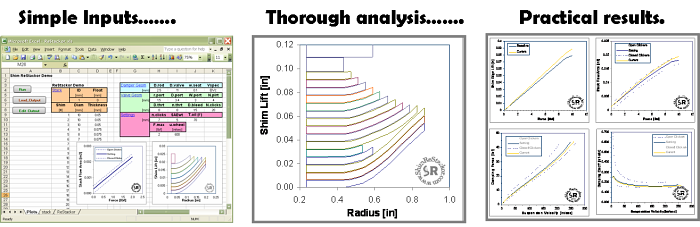
The baseline Shim ReStackor code allows you to compute the stiffness of your current shim stack and compare potential stack modifications in terms of you many "clicks" stiffer or softer the modified stack will be. In the example below the stack clamp diameter was increased. The larger clamp produces high speed damping rates equivalent to riding your current stack with the clickers fully closed. If this is beyond the change you intended you then know you need to work on the stack taper, not the clamp diameter. 


Shim ReStackor references shim stack changes in terms of clicker settings allowing you to easily interpret the effect of each change to the shim stack.

The capability of Shim ReStackor to reference stack stiffness to the clicker settings can save you a huge amount of time tuning shim stacks. The clicker reference allows you to use your real world riding experience to evaluate shim stack changes and search for stack configurations that provide two clicks stiffer high speed damping or insert a crossover shim to provide three click softer low speed damping while maintaining the original high speed damping rate. Using software to evaluate these changes allows you to confidently change the stack face shim and clamp diameter to get the stiffness you want without getting wrapped up in the age old question: Is this stack stiffer or not?. Tuning in software also allows you to test hundreds of stack configurations to find the best combination of face shims and stack taper and the clicker reference of ReStackor lets you eliminate stacks that are "way outside the box".

ReStackor uses physics based relationships to accurately compute shim stiffness

ReStackor integrates Hooke's law and Young's modulus of elasticity through the curvilinear coordinates of shim to evaluate the internal stresses created when the shim is bent. These same physics based stress integrations are used in the design of leaf springs and coil springs, are well known and well anchored through years of industrial spring manufacturing technology. Within the limits of material property definitions these spring design equations are exact. (more)

Detailed force balance used to accurately compute stack stiffness and interactions of design features within the stack structure

A central feature of ReStackor is the capability to compute a detailed stack force balance, accurately account for stack edge lift and the complex stack structures used in practical shim stack configurations. The ReStackor force balance includes effects of shim thickness, stack taper, clamp diameter, crossover shims, backing shims and the interactions of these features as the stack structure changes at different edge lifts. A stack of 50 shims requires ReStackor to solve 4950 simultaneous equations to determine the stack structure and edge lift values. (more)

ReStackor shim stack force balance solves 5,000 simultaneous equations to determine the stack stiffness.

Shim stack deflection calculations anchored to real world dyno data

Calculation of stack stiffness means nothing if the calculations can not be shown to match real world test data. The shim stack deflections and flow resistances computed by ReStackor pro have been anchored to real dyno data using real world suspension components and real world valve stacks. Comparison of ReStackor calculations to dyno test data are reviewed here.


ReStackor calculations have been anchored to the dyno test data of www.SuperCrossOnline.de

Valve port flow area

Simple calculation of stack edge lift is inadequate to determine the actual fluid flow area at the valve face. The flow area is a function of the valve port geometry and the bend profile of the stack face shim. To determine this flow area ReStackor integrates the flow area along the outside edge and side of the valve port seat to determine the available flow area and accurately account for face shim bend profile effects. This allows ReStackor to interpret the subtle effects of stack taper on the valve port flow resistance due to changes in the face shim bending profile. (more)


ReStackor accounts for effects of face shim bend profiles in evaluation of fluid flow area available at the valve face.