


ReStackor Viscosity relationships use real world commercial suspension fluids
Peter Verdone has compiled an excellent summary of the viscosities of commercial suspension fluids. ReStackor pro uses Silkolene viscosity data from Verdone's web site to establish the relationship of SAE wt to fluid viscosity. Effects of temperature on fluid viscosity are scaled in ReStackor using the Andrade[1] relationship. This allows ReStackor to match viscosity data reported at cSt@40c and cSt@100c as well as reliably compute viscosities at room temperature or sub-zero temperatures.

Accurate modeling of fork oil and shock fluid viscosity allows the fluid dynamic calculations of ReStackor pro to accurately compute flow losses in the valve port entrance and skin friction loss through the valve port and bleed circuits.
The data compiled by Verdone shows considerable scatter in the viscosities of commercial suspension fluids. The viscosity of 10wt fork oil can be anywhere from 2.5wt to 15wt oil. This wide range of variation can lead to unpredictable results if you don't know the actual viscosity of the fluids you are using. Special care is needed if you are trying to evaluate suspension performance through changes in the oil viscosity, even if the oils you are using are from the same manufacture.
[1] Reid, R.C., Prausnitz, J.M. and Sherwood, T.K.,”The Properties of Gases and Liquids”, McGraw-Hill 1977.

ReStackor Viscosity Relationship for SAEwt
The SAEwt viscosity relationships built into ReStackor are consistent with the viscosities reported on Verdone's web site. In addition to this data ReStackor uses the Andrade relationship to accurately scale effects of oil temperature on viscosity. This allows ReStackor to estimate the effect of suspension fade when the shock oil heats up under hard use.
ReStackor calculations use the Andrade equation to correct for oil temperature effects.

The plots above show the viscosity and oil temperature effects built into ReStackor. If you know the viscosity of the oil that you are using in terms of centistokes you can use the plots above to determine the "effective" SAE wt. The temperature of the fluids used is also very important. Using SAE 5wt at 60 F is equivalent to using SAE 9 wt at 100 F. Due to this temperature effect, drawing conclusions of suspension performance based on a test ride requires some estimate of the oil temperature the suspension was operating at.
Hydraulic fluid compressibility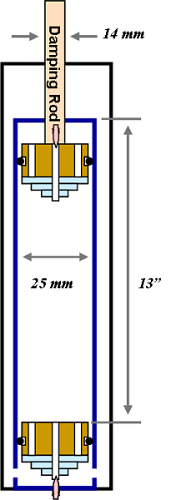
Motorcycle suspension fluid manufactures don't make the compressibility of suspension fluids available but the effects of compressibility can be estimated using the standard rules of thumb for hydraulic system design. Compressibility of hydraulic fluids typically result in a volume reduction of 1/2% at 1000 psi, engineers edge .
Assuming a length of 13 inches for a fork compression chamber and a diameter of 25 mm the volume of the compression chamber is 162 cc. If the pressures in the suspension circuit were to suddenly spike to 500 psi the oil compressibility would cause the fluid volume to reduce by 0.405 cc. This volume reduction would allow the damper rod to move 0.1 inches. The 0.1 inches of uncontrolled motion caused by compressibility of the fluid is known as surge in hydraulic systems.
In reality deflection of the seals, expansion of the compression tube and compressibility of the oil foam or dissolved gasses are larger effects than oil compressibility. Hydraulic fluids are, by design, virtually incompressible.
Hydraulic Fluid Vapor Pressure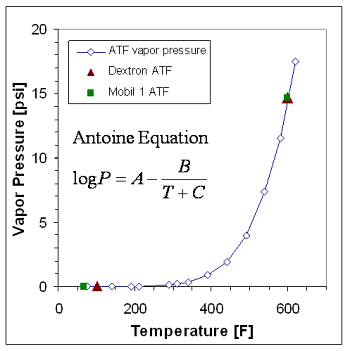
Suspension cavitation limits, cavitation recovery limits and suspension valve fluid flow rates under cavitating conditions are dictated by the fluid vapor pressure downstream of the valve. ReStackor computes fluid vapor pressure as a function of temperature giving ReStackor the capability to compute changes in cavitation limits as fluid temperatures change under race conditions.
The material safety data sheets available for Mobil 1 ATF give the vapor pressure at the normal boiling point and at atmospheric conditions. Chevron has made available additional data for Dextron automatic transmission fluid. The combined data is almost enough information to estimate the vapor pressure curve using the Antoine equation (1).
At the normal boiling point of water (212 F) the vapor pressure of ATF is less than 0.1 psi and pressures don't approach atmospheric pressures until the 600 F range. By design, the vapor pressure of fluids used in suspension systems are very low to resist cavitation. As long as you can keep the shock temperature somewhere within the range of the normal boiling point of water (212 F) the typical design assumptions of zero psi vapor pressure is reasonable for estimation of shock absorber cavitation limits.
1: Antoine, Compt. rend., 107 (1888)
